

Job seekers are turning to AI to send out dozens or hundreds of applications at a time. Employers, in turn, are using AI to filter those applications out just as quickly, creating what some have referred to as an AI arms race in hiring.
01. How AI is taking over job-seeking
In February 2026, Side Hustles conducted a survey that found that the majority of workers use AI in at least some fashion when applying for jobs.
This has been backed up by other recent studies, too. Millions of people now use Gemini, ChatGPT, and other AI models to write their resumes and cover letters; our survey found that more than one in three workers are open to trying this or have already done so.
Others have gone well beyond that and have started using AI software to automate the entire process of job-hunting, including searching job boards for gigs, filling out applications, and submitting them.
AI-powered job application agents
AI tools that automatically apply for jobs are often referred to as “agents.” One of the most popular is called LazyApply. Developed by an Indian company that also offers other job-related AI products, such as a resignation letter generator, it allows job hunters to “apply to jobs across multiple platforms with a single click.”
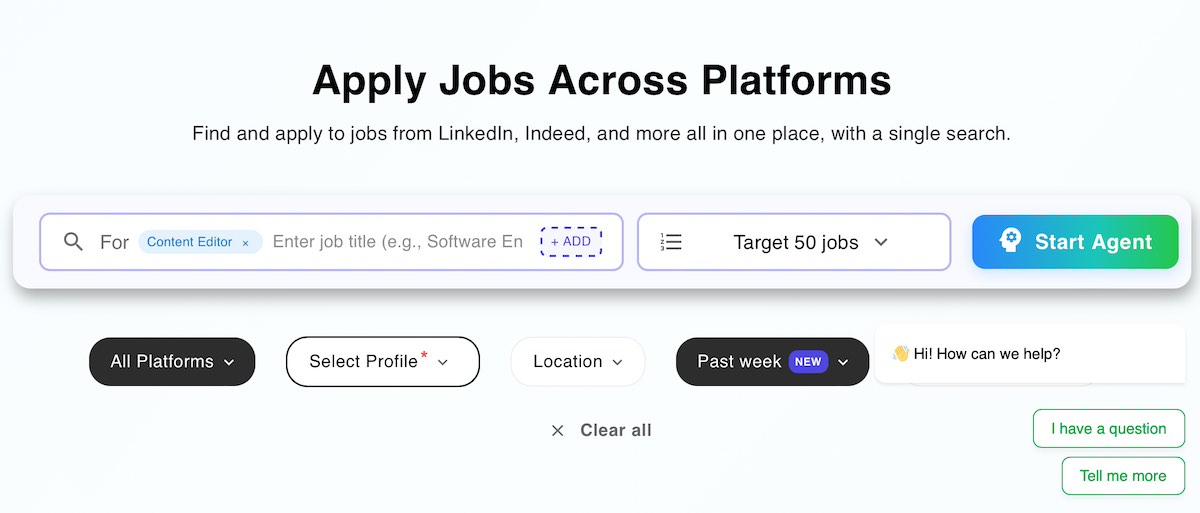
LazyApply’s approach is sometimes characterized as “spray and pray”—an accurate description, if an unflattering one. Agents like these are designed to submit as many resumes in as short a time as possible, generally without personalizing them to each job (or only doing so in a quick and superficial way).
In most cases, the vast majority of these applications will be rejected, but if even a fraction lead to interviews, the strategy can pay off. The goal is to save time and stress and maximize the chances of landing a job, any job, even if that means that each individual application suffers in quality.
How popular are AI auto-appliers?
LazyApply is far from unique. Its most notable competitors currently include JobCopilot and Sonara AI. More are virtually certain to enter the market in the years to come.
Not long ago, tools like this were mostly unknown. In 2023, Wired ran a story framing them as a new, disruptive technology. Since then, they’ve grown in popularity, although it’s hard to say exactly how many people are using them, as none of their developers have released independently confirmed download numbers or registration data.
As of March 2026, LazyApply’s Chrome browser extension has over 20,000 users, and JobCopilot claims to have over 100,000 (although both have relatively few user ratings on review platforms like Trustpilot). Data from the search engine analysis tool Ahrefs shows that between 5,000 and 10,000 people search for branded terms like “lazyapply” and “jobcopilot” every month, with a further few thousand searching generic queries like “ai that applies to jobs for you.”
The limited data suggests that there are tens (although probably not hundreds) of thousands of people using auto-apply agents in the US. Their user base probably skews fairly young, with tech-savvy Gen Z and Millennial workers being overrepresented.
An imperfect solution
Auto-apply agents aren’t perfect. Many of them are still developed by small startup teams, and they tend to be prone to glitches, which can range from the minor (neglecting to apply to certain jobs) to the serious (adding incorrect information to resumes or breaking and failing to function entirely).
Consequently, they often get polarized reviews. Some people swear by them, but others still recommend a quality-over-quantity approach when applying for work.
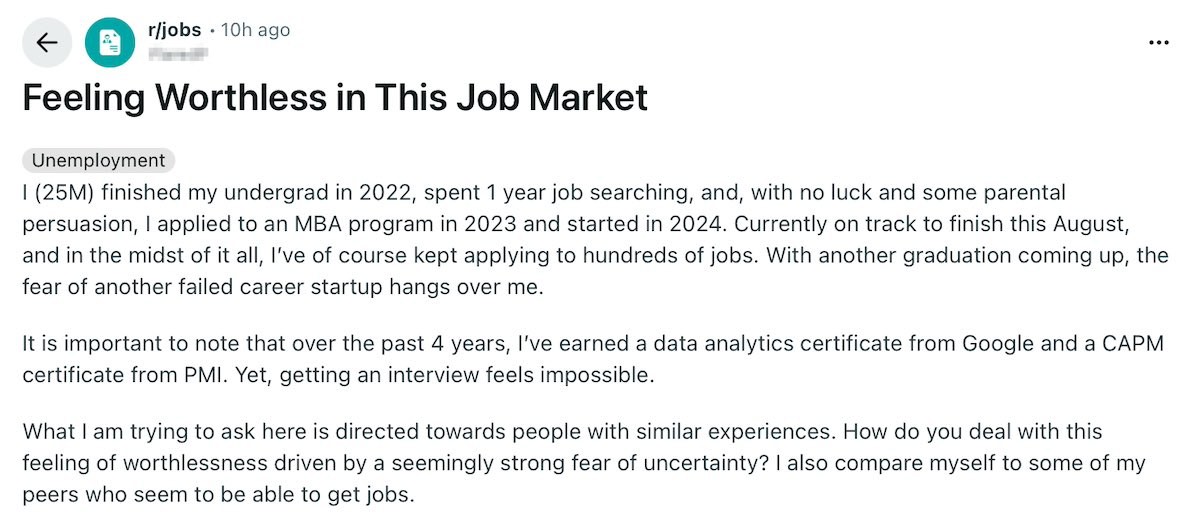
Regardless, auto-appliers have undeniably carved out a niche for themselves. It’s especially common to see them mentioned on online message boards like Reddit’s r/jobs, a place where frustrated job seekers commiserate about their struggles and swap tips on how to job-hunt in an increasingly tough market.
02. How companies feel about AI auto-appliers
Many recruiters and hiring managers take a dim view of AI-generated spray-and-pray applications because they tend to feel generic and “samey,” making it hard to evaluate candidates. Moreover, they arrive in overwhelming numbers that can easily swamp HR teams with limited manpower.
Peter Swimm, a prominent AI consultant, told The Muse that employers see this kind of behavior as “a way of gaming the system and robbing them of their ability to evaluate talent.” One recruiting manager quoted by Wired was blunter: “It’s like asking out every woman in the bar, regardless of who they are.”
This sentiment was echoed by several other HR professionals we spoke to. Milos Eric of OysterLink, a job platform aimed at hospitality workers, told us that mass-applying has the potential to make things harder for other job seekers as well as employers.
“Recruiters get flooded with irrelevant and generic applications, leaving even highly qualified candidates lost in the shuffle,” he said.
03. Why do people use AI to apply for jobs?
Some recruiters suspect that applicants who use AI are just being lazy. Some of the time, they might be right, but there’s another reason many candidates may be turning to AI: simple math.
The job market in 2026 isn’t very good. Ironically, some have argued that AI-related layoffs are responsible for this, at least in part.
On March 6, the Labor Department reported that employers had cut over 90,000 jobs in February and that there had been essentially no growth for the past three months. The New York Times characterized the past year of hiring as “anemic,” and in January, NPR described the job market as “broken.”
An incentive to mass-apply
The low-hiring environment encourages the practice of mass-applying. Especially in competitive industries, many candidates report needing to send out dozens or hundreds of resumes to land a single interview. In Eric’s words, “Hiring processes are making many candidates feel like they’re applying into a void.”
Hard data on this is scarce, but anecdotes about it litter the internet. In one highly upvoted post on Reddit’s r/recruitinghell, for instance, one user recently claimed to have helped her husband fire off 460 job applications during a two-and-a-half-month span. Others chimed in with similar stories.
The cost of filling out every application manually
Mass-applying to jobs takes time—a lot of time. Our survey found that the average time to prepare a job application by hand (without AI) is nearly 52 minutes.
Doing that dozens of times means cumulatively spending days applying for jobs, all without any guarantee the effort will pay off.
Given how the math works out, it’s inevitable that some job seekers will try to streamline the process with AI, even if they know employers don’t like it and it may cost them opportunities if they get caught.
04. AI on the employer’s side
Job seekers have their own complaints about AI.
As early as 2021, The Wall Street Journal reported that many companies were using automated systems to screen candidates in huge numbers, leading to millions of resumes getting rejected without ever being seen by a human being.
The WSJ noted that “nearly nine out of 10 executives” acknowledged that “the software they used to filter applicants [prevented] them from seeing good candidates,” but they continued to use it because it made the chaotic process of hiring more manageable.
This type of screening has only gotten more prevalent with the onset of applicant-tracking systems (ATSes) powered by advanced AI models.
In 2025, the UK publication The Week claimed that 80% of large companies were using AI “somewhere” in their hiring process, and one in four were using it to automate the whole thing.
The so-called AI double standard
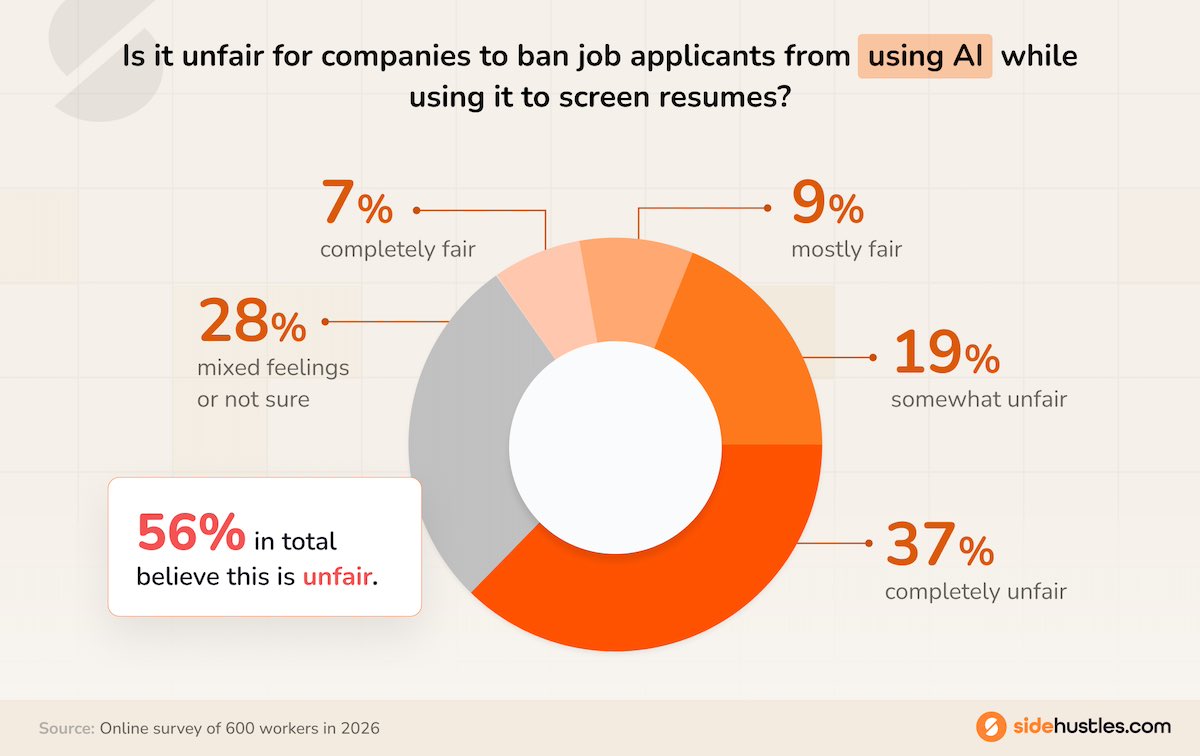
AI’s influence in hiring has drawn a certain amount of ire from job seekers, who are upset that many companies forbid them from using AI to apply for work while freely using AI themselves.
A significant majority of the respondents to our February survey told us that they considered this an unfair double standard.
Many also expressed concern that AI systems might be biased against candidates due to factors like their age, ethnicity, or gender.
Legal restrictions on AI in hiring
The possibility that AI hiring systems might be prejudiced—in other words, that they might reflect the biases of their makers—has drawn media attention, as well as the attention of lawmakers.
In 2021, well before the rise of AI models like ChatGPT, New York City introduced Local Law 144, obligating companies that use screening software to regularly audit it for bias.
Several states have introduced similar legislation, including Louisiana’s House Bill 421, which forbids AIs from inferring a worker’s membership in a protected class (e.g., their sex or gender), as well as requiring employers to disclose the use of AI to candidates.
While these bills limit how AI may be used in hiring, the basic imbalance—some companies disqualify candidates who use AI while liberally using it themselves—remains. Daniel Kalish, the founder of HKM Employment Attorneys LLP, an employment law firm, told us that he sympathizes with workers who find this unfair, but that the practice is probably here to stay.
“It absolutely is a double standard,” he said. “But a company, unfortunately, can engage in double standards if it wants.”
Filters, quizzes, and chatbots: how AIs screen candidates
In addition to applying an ever-finer level of scrutiny to candidates’ resumes, often filtering based on the specific keywords and automatically rejecting people with small gaps in their employment histories, many AI-based ATSes now require applicants to have an initial chat with a web-based bot.
“Screening agents” like this often pepper applicants with questions designed to disqualify a certain number before they’re even allowed to submit a resume.
What it’s like to chat with a hiring bot
The biggest provider of these agents is a company called Paradox, whose “Olivia” bot has been adopted by major retail and fast food chains in the US, including CVS, McDonald’s, Taco Bell, and 7-Eleven.
To gauge what dealing with these bots is like, Side Hustles tested Taco Bell’s hiring portal by trying to apply for an Assistant General Manager position. We were paired with a cheerful taco, “Bella”—a rebranded Olivia.
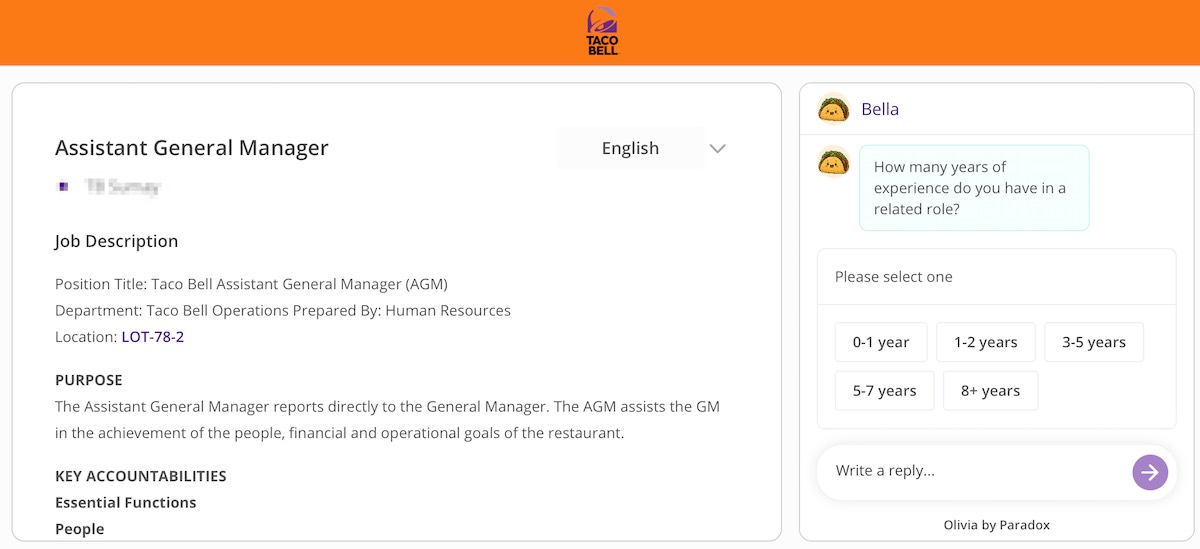
Bella asked us questions like “How many years of experience do you have?” and “Are you planning to work for Restaurant Brands for more than 4 months?” (Restaurant Brands is the parent company of Burger King and other major fast food chains; it also owns several Taco Bell franchises.)
None of our initial answers disqualified us, but when we passed Bella’s screening, we still weren’t able to submit a resume. Instead, we were advanced to a further “90-second screening”—provided by a company called Traitify—that was meant to gauge our personality.
In it, we were shown a series of CGI cartoon images with captions like “Perfectionist,” “Natural Leader,” and, somewhat bizarrely, “Skydiving” and “Wearing Costumes.”
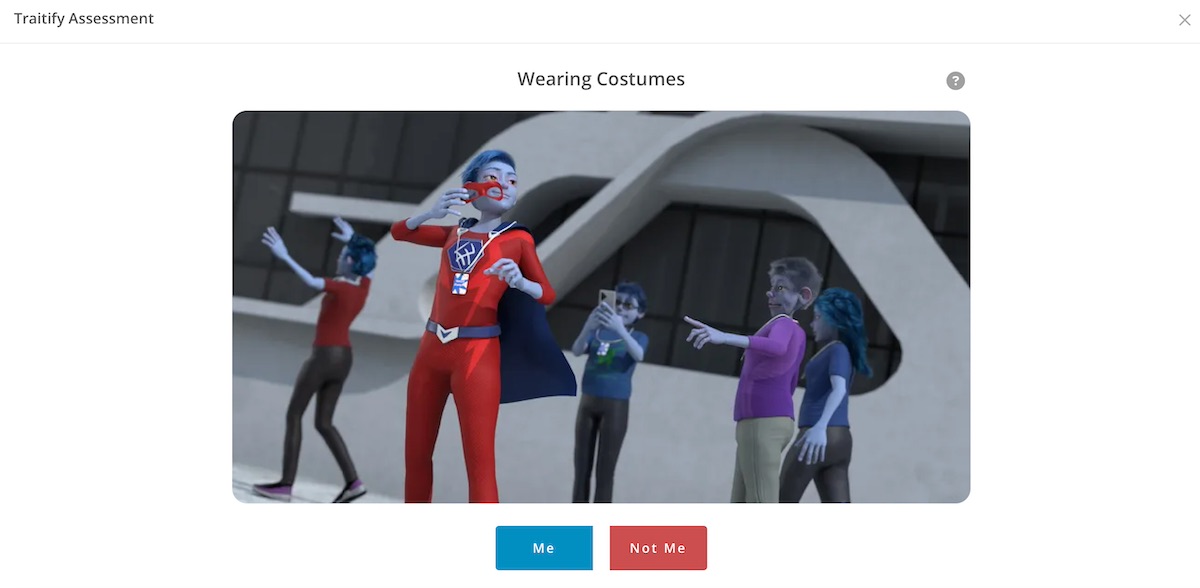
After completing this secondary screening, we were redirected back to Bella the taco, who informed us that “a member of our team will reach out in the next 1–2 days” if they decided we were a good fit.
All of this took considerably longer than the promised 90 seconds.
An incentive to automate on both sides
AI pre-screenings do not, of course, always match the tone that Traitify struck here. When companies question candidates for white-collar gigs, they tend to ask straightforwardly about their experience, expectations regarding company culture, and so on.
However, the common element between those funnels and Taco Bell’s is the investment of time required to complete them.
This is almost certainly part of why many candidates are turning to AI themselves. When completing a single application is this arduous, it encourages people to automate the process. Similarly, when only a minority of applications ever make it past the screening stage, it encourages people to take a scattershot approach, firing off as many as possible.
The result is a vicious cycle—an “AI arms race,” as The Week characterized it.
05. What the future holds
The obvious question is where things are going from here. It’s easy to imagine that AI’s role in hiring will continue to escalate until the process at most companies is almost fully automated, with bots chirping back and forth about machine-written resumes and actual human beings increasingly taking a back seat throughout.
We reached out to several recruiters and HR professionals for comment. Most were skeptical that things would go that far, saying they expect AI to play an important part in hiring from here on out, but that they don’t think it will ever come to completely dominate it.
Matt Erhard of the Summit Research Group, a Canada-based recruiting firm, told us that on the employer side, hiring decisions require “nuance that AI alone can’t achieve.”
“While the early stages of hiring are likely to become more automated, the process will continue to become more human the closer a candidate gets to an offer,” he said.
The future of AI for candidates
Few people we talked to said that in the future, job applicants will be represented by AI agents throughout every stage of hiring. The general consensus was that businesses will always want face-to-face time with serious candidates, and that they’ll find ways to filter out people using AI to generate their application materials.
Most also told us that in the here and now, they recommend against using spray-and-pray tools like LazyApply. In Erhard’s words, “Recruiters can tell when an application was sent without real interest in or consideration for the specific role.” He added that in his experience, those types of applications rarely move forward.
“Having said this, I also acknowledge the reality that AI is part of the professional toolkit on both sides,” he said.
He said that people using AI to “polish their resume or structure their cover letter” is “not fundamentally different from using a career coach or editing software” as long as the contents remain genuine.
“I don’t see outright bans of AI as the best approach moving forward.”
What today’s job seekers think
Most of the workers who responded to our February survey seem to agree with Erhard’s sentiment. Despite the growing popularity of AI, over two-thirds told us that even in a tough market, manually applying is the best way to succeed.
Of course, that’s how people feel given the state of the technology now. If, in a few years, AI agents have advanced enough that they’re truly indistinguishable from the people they represent—and a spray-and-pray approach doesn’t mean compromising the quality of each application—will they still feel that way?
That’s something that only time will tell.